
1/27/2005
slide 14

“VJ Day,” 1945
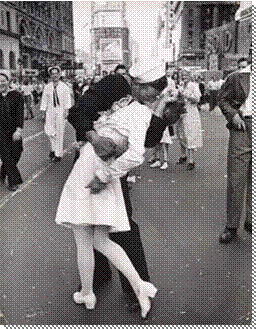
Alfred
Eisenstaedt
| So today we have
more images than ever but still a great deal of suspicion and lack of
understanding about how images “work” and about their role in academia and
elsewhere. |
|
| Let’s switch modes
for a minute and instead of talking about images in general, let’s look at a
few of the images from the slide show because meaning and intent are not
always obvious… |
|
| and we’ll discuss
how different disciplines can add different perspectives to looking at an
image… |
|
| An important
distinction is “looking at/perceiving” vs. “interpreting” |
|
| •Let’s do some interpretation of an image from the slide
show- because meaning and intent are not always obvious… |
|
| •Starting with caption actually, not even image yet: |
|
| •ASK how many know what “VJ” stands for |
|
| •not captioned “WWII Day” (tells us something about
the times in which it was taken) |
|
| •LIFE caption: “Photographers across America captured
victory kisses on August 14, 1945, the day World War II came to an end. So
why did one embrace become a universal symbol of jubilation - and perhaps the
most reprinted image in LIFE's history? Having spied a sailor smooching his
way through Times Square, Alfred Eisenstaedt followed until he found the
perfect composition - a confluence of lines and curves that draws the eye
into a vortex of pure joy.” --reads as an unambiguously happy event |
|
| •But look at the
rather strange positions of the two figures—the man appears to
have his girlfriend in a head lock—and her hand hangs lax, not
embracing him at all. We might use research from psychology and
anthropological approached to
human gesture and body language interpretation to further analyze this
image, as well as media theory issue of gender expectations. Would
this be a canonical picture if the woman was dressed very differently, for
instance? |
|
| •And just formally, what contribution did the black
and white outfits have on the aesthetic of this b&w photo? |
|
| •I wondered about the strange pose and did some
research online. Here’s what Eisenstaedt himself had to say about the image: |
|
| •“VJ Day in Times Square on August 15, 1945 provided the
opportunity for Eisenstaedt to photograph the image for which he is possibly
most famous. "I saw a sailor running along the street grabbing any and
every girl in sight." he explained. "Whether she was a grandmother,
stout, thin, old, didn't make any difference. I was running ahead of him with
my Leica looking back over my shoulder...Then suddenly, in a flash, I saw
something white being grabbed. I turned around and clicked the moment the
sailor kissed the nurse." Eisenstaedt was very gratified and pleased
with this enduring image. "People tell me that when I am in heaven they
will remember this picture."
“http://artscenecal.com/ArticlesFile/Archive/Articles1997/Articles0397/AEisenstaedt.html |
|
| Mores of the
times: So instead of say boyfriend returning to girlfriend, this is an
aggressive, really somewhat weird, photo… today man would have been slapped
or had complaint filed against him instead of been made famous in this
picture… |
|
| Gender issue:
At the same time, there are tons of pictures of French girls throwing
themselves at the liberating American
GIs marching in the streets of Paris. Even back then, women kissing GIs seems
less offensive (if at all) than the reverse… |
|
| Nationality issue:
Would this same image with Eiffel tower in back have angered the French?
Probably |
|
| SOURCES |
|
| _________________________ |
|
| •1945: Alfred Eisenstaedthttp://www.life.com/Life/millennium/photos/eyerman.html |
|