
1/27/2005
slide 15

“Execution
of a Viet Cong Guerrilla,” 1968
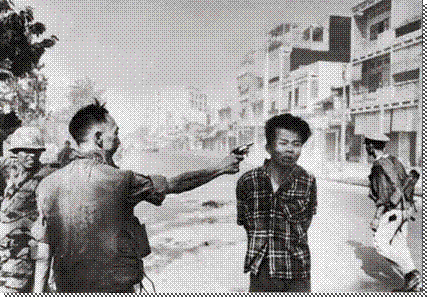
Eddie
Adams
| And what about
this, also famous image? |
|
| Execution of a
Viet Cong Guerrilla 1968 |
|
| Photo Eddie Adams/AP |
|
| •LIFE: “With North Vietnam’s Tet Offensive beginning, Nguyen
Ngoc Loan, South Vietnam’s national police chief, was doing all he could to
keep Viet Cong guerrillas from Saigon. As Loan executed a prisoner who was
said to be a Viet Cong captain, AP photographer Eddie Adams opened the
shutter. Adams won a Pulitzer Prize for a picture that, as much as any,
turned public opinion against the war. |
|
| •NOT what Adams had intended: |
|
| •he felt that many misinterpreted the scene as one of
a horrific act with the implied villain the man shooting the other man in the
head. |
|
| •when told in 1998 that the immigrant Loan (the
shooter) had died of cancer at his home in Burke, Va., he said, “The guy
was a hero. America should be crying. I just hate to see him go this way,
without people knowing anything about him.” |
|
| •Interesting that interpreting imagery, including something
as basic as understanding the role of captioning is not formally
taught in any required course in college. |
|
| •critical readers and not to believe everything we
read, but it’s equally important not to look assume that images have
obvious, unambiguous messages |
|
| •Understanding this image draws on issues in photojournalism,
the cognitive science area of understanding how we related text and
images and how they can work best together, and again formal compositional
issues—it’s not just a picture of someone being shot in the head, without
judging content in any way, it also is an excellent composition. |
|
| One could also look
at the neurological issue of
how process images of violence, pictures of faces, etc. New research shows different
facial emotions are processed in different areas of the brain. |
|