|
|
|
|
|
|
•with the advent of computer graphics and the Web has it
become, as it was thousands of years ago,
almost as easy to make and distribute images as it to make and
distribute texts.
|
|
this change has set
off a chain reaction, an exponential growth in the use and exchange of images
that is changing our lives.
|
|
|
|
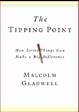
•Malcom Gladwell, in his book “The Tipping Point”, suggests
how these types of dramatic change can come about.
|
|
•SLIDE POINTS
|
|
•Creating a discrete way of making and showing images
isn’t just a convenience, we believe it is
a tipping point for images, and thus for the need for visual
literacy.
|
|
•ANALOGY: invention of the printing press made textual
communication profoundly easier and created a need for textual literacy,
so CG and Web are creating a need for
visual literacy (there was need before but this is tipping point).
|
|
|
|
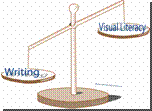
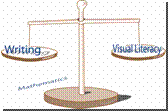
•It is time once again to integrate visual education with
the textual and mathematical
|
|
EXTRAS
|
|
_________________________________________
|
|
1. What is The
Tipping Point about?
|
|
It's a book about
change. In particular, it's a book that presents a new way of understanding
why change so often happens as quickly and as unexpectedly as it does. For
example, why did crime drop so dramatically in New York City in the
mid-1990's? How does a novel written by an unknown author end up as national
bestseller? Why do teens smoke in greater and greater numbers, when every
single person in the country knows that cigarettes kill? Why is word-of-mouth
so powerful? What makes TV shows like Sesame Street so good at teaching kids
how to read? I think the answer to all those questions is the same. It's that
ideas and behavior and messages and products sometimes behave just like
outbreaks of infectious disease. They are social epidemics. The Tipping
Point is an examination of the social epidemics that surround us.
http://www.gladwell.com/tippingpoint/index.html#whatis
|
|
|
|
•Similar to: Idea of memes and memetics
|
|
•Meme: an information pattern, held in an
individual's memory, which is capable of being copied to another individual's
memory.
Memetics: the theoretical and empirical science that studies the
replication, spread and evolution of memes
|
|
•A meme is a cognitive or behavioral pattern that can be
transmitted from one individual to another one. Since the individual who
transmitted the meme will continue to carry it, the transmission can be
interpreted as a replication: a copy of the meme is made in the memory
of another individual, making him or her into a carrier of the meme.
This process of self-reproduction (the memetic life-cycle), leading to
spreading over a growing group of individuals, defines the meme as a
replicator, similar in that respect to the gene (Dawkins, 1976; Moritz,
1991). http://pcp.lanl.gov/MEMES.html
|
|
|