
Combined Color Mixing
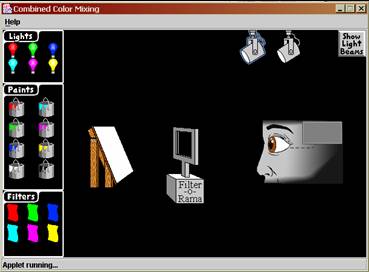
| Pink
light, yellow paint = red light |
|
| Cyan
filter, white paint, mag light |
|
| Additive
and subtractive can seem to be two different worlds but really two ways of
looking at the same thing—different wavelengths reaching your eye. Some might
come from a light course—example in room—some come from an object reflecting
light (--example in room. ) |
|
| One
color light on white board. |
|
| Make
white light (y and b) |
|
| Cyan
board, b,y lights. |
|
| Yellow
light, cyan board: cyan is absorbing non-cyan colors, namely red (b and g
make cyan) |
|
| Yellow
light is r + g mixed. When the red part is absorbed, result I green. |
|
| Filter
is subtractive—filters out some wavelengths (everything but the color of the
filter…) |
|
| Y light,
white surface, no filter |
|
| Y light,
white surface, M filter. =- red light (absorbs g let s r through) |
|
| You can
play with this—point is that light emitting, reflection, absorption is taking
place all at once in the real world. |
|