
Beyond 2D
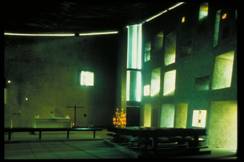
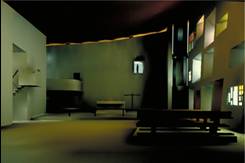
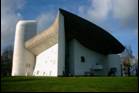
Le Corbusier chapel in Ronchamps, France
| Color in
real 3D space is influenced by material properties (texture, etc) |
|
| By
rendering methods |
|
| Many
material’s colors cannot be accurately depicted yet—complex
reflections/diffraction in oil, color from surface of skin… etc. |
|
| Very
difficult to predict color effects in 3D… |
|
| One of
the ways that digital color can help is by mathematically simulating
real-world color: light and material interactions and effects that change as
you view them from different angles. |
|
| Many
computer-generated images lack subtle color effects. Even ray traced images,
which can look very realistic , often have a harsh feeling. |
|
| Radiosity:
calculates all the light energy in the room as it bounces off all of the
surfaces. Very “computationally expense” as they say in the CS world… beautiful results. |
|
| Possible
now to do very good simulations of light effects and experiment with and
predict 3D results. |
|
| I would
think would be a more and more useful tool for lighting design… |
|
| 3D
programs also simulate real world lighting. User chooses object colors and
materials and light colors -- the
results are calculated using algorithms based on real-world additive and
subtractive color mixing. |
|
| 10 years
from now, digital color tools will be much more powerful, especially for
artists and designers working in 3D and with complex lighting and material
considerations. |
|
| All the
basic concepts we just covered will still apply… even more important since
easier to be fooled, have to retain critical judgment… |