|
1
|
- Agenda
- Computer art
- Assignment preview
- One critique, possibly two
- End of 3D
- Interested in a critique from Walker? Email ams@cs.brown.edu
- He’ll be here April 4,5, and 6
- Reading Handout
|
|
2
|
- Origins
- Controversy
- Future
|
|
3
|
- Integration of disciplines
- Art and design (Is it art? What traditional criteria apply? What new
criteria?)
- Semiotics (how does computer art make meaning? What do we need to know
to understand it?)
- Discourse theory (how have the discourses of science and art interacted
in the field of computer art?)
- Perception—many early works done as perception studies, e.g., Knowlton
Nude at Bell Labs
- Computer graphics (ever-changing technology affected what could be done
and by whom)
- See original works (from early days, esp)
|
|
4
|
- Ironically, for a medium in which “original” has complex meaning, it’s
hard to view these works
- Don’t reproduction well
- Many plotter pieces use fine, delicate lines
- Small jpg’s on web give little sense of feeling of real work
- No high-quality posters available (as with well known movements like
Impressionism)
- Few coffee-table type book with really good reproductions, in color
- No permanent displays in museums
- 2D static computer-based work has met with great hostility
- 3D and time-based works and performance an installations more easily
accepted
|
|
5
|
- This is why today’s class will be based on examination of real pieces
- This history is happening now—most of the artists still alive, but…
- “For many of its critics, computer art was the product of many
discursive assumptions, methodologies, and vocabulary as science.”
- Victim of “sustained hostility toward the computer”
- Sign of “subordination of the individual to the emerging technocracy”
- Seemed more in line with modernist abstract work—seemed outdated to
postmodernist artists and critiques
|
|
6
|
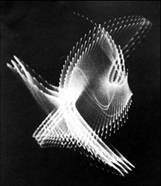
- Ben Laposky, Oscillon #4 (1954-1956 ) [photo of screen]
- Ken Knowlton and Leon Harmon, Nude (1957) [originally mural-sized, this
is reproduction]
- More Knowlton: http://www.knowltonmosaics.com/
- Michael A. Noll, Gaussian Quadratic (1965)
- Vera Molnar, seria: interruptions (1968-69/1983)
- Manfred Mohr, P-159 (1973-74)
- More Mohr http://www.emohr.com/
- Cynthia Beth Rubin, doorways piece (1990s)
- More Rubin http://www.cbrubin.net/
- Roman Verostko, Diamond Lake Apocalypse (1994)
- More Verostko http://www.verostko.com/
- Jean-Pierre Hebert, Minotaure: detail, date?
- More Hebert http://hebert.kitp.ucsb.edu/gallery/perso.html
- Algorists http://www.verostko.com/algorist.html#hebert
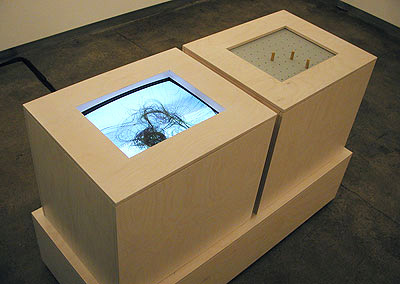
- James Faure Walker –piece from office—
- Moore Walker http://dam.org/faure-walker/artworks.htm
|
|
7
|
- Lillian Schwartz and Ken Knowlton
- Films from 1970s, created with Knowlton’s EXPLOR animation language at
Bell Labs
- Stan Vanderbeek and Ken Knowlton
- Poemfields and Man and His World (late 1960s)
- Ken Knowlton
- 9 Spots
- Leon Harmon and Ken Knowlton, Studies in Perception I (aka “Nude”),
1966
- Michael A. Noll 3D
- Ballet (stereo) and 3D Ballet (non-stereo)
- Edward E. Zajac
- Simulation of a Two-Gyro Gravity-Gradient Attitude Control System,
1961
- R. N. Shepard and Edward E. Zajac., Pair of Paradoxes
|
|
8
|
- Out of print books
- Ruth, Leavitt (Ed.) Artist and Computer, 1976
- Catalogs from computer art shows, including
- Cybernetic Serendipity, 1968
- "The machine as seen at the end of the mechanical age” 1967 MOMA
show
- Lots more…
|
|
9
|
- Paul Brown Part of Algorists, animated and interactive work based on AI
algorithms http://www.paul-brown.com/GALLERY/TIMEBASE/SANDLINE/SANDSND.HTM
- Casey Reas Animated and interactive works. http://www.groupc.net/
- The Digital Art Museum (DAM) http://www.dam.org
- Teleculture site http://www.teleculture.com
- BitForms Gallery, NYC http://www.bitforms.com
- SIGGRAPH Art Shows online http://www.siggraph.org/artdesign/
|
|
10
|
- 2D computer prints
- The separation between computer printmaking and traditional printmaking
will disappear.
- 3D computer sculpture
- The use of rapid prototyping for traditional mold-making will help
unite traditional and new media. approaches to 3D art works.
- Animation
- Use of the computer is now clearly necessary but not sufficient.
- Photography
- As prices of digital cameras continue to plummet and quality continues
to soar, traditional film cameras will become obsolete collectors
items. Interactive art
- Virtually all artists engaged in creating interactive works will
consider the computer a useful too and incorporate it routinely.
- In the near future, static 2D and 3D visual computer pieces will seem to
relate more to their traditional counterparts than they will to, say, an
interactive and AI-based installation experience.
|
|
11
|
- Overview
- Create a fine art piece that depicts or evokes a modern landscape. Use
a variety of types of mark-making, at least in part by combining 2D
raster and geometric elements
- Technical details
- Final pieces must be computer files (i.e., not paintings or other
media)
- Final pieces can be viewed on screen or printed
- Yes, you can scan in things to get more mark variety (drawings,
paintings, whatever) but you still need to use at least two types of
graphics software as well—2D raster and vector, or raster and 3D, etc.
- No size constraints. If file is over 20MB make me a CD or email me for
a ftp address.
- Does not have to be representational
- Advice
- Unlike the more graphic design-oriented projects we have done to date,
you do not need to begin with any specific “message” you want to
convey.
- Start with a landscape or landscape object that appeals to you--even if
you don't know why. You can go on-site and photograph it with a digital
camera, get pictures from the Web, or draw things and scan them in.
- When you reach stopping points in the work, then take time to sit back
and think about what it might be saying and whether it's working. At
these points you can employ the concepts from semiotics and design that
we covered in class. Don’t
analyze while you work!
|

 Notes
Notes