1/27/2005
   slide 7
Globalization
•Universal language
•Film and TV are the US’s second largest export after aerospace. $3.6b to Europe alone in 1992
Visual Culture, Nicholas Mirzoeff
•
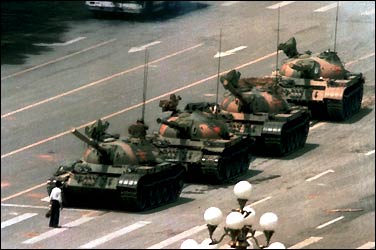
Jeff Widener/AP
Richard Baum, director, Center for Chinese Studies at UCLA, says there's "an emotional legacy to that shot. I think that has cost China more in public image than any other single image in modern times." http://pekingduck.org/archives/000935.php
•
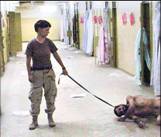
Abu Ghraib
The visual is not always a transparent global language, but it’s often much more transportable than words.
The image of the students in Tiananmen Square were readable by both Westerners and those in China.
So were images of the Trade Centers collapsing, and more mundane things—what celebrities look like and like to wear.
FACTOID: Film and TV are the US’s second largest export after aerospace 3.6b to Europe alone in 1992 (Barber 95:90) Visual Culture , Nicholas Mirzoeff

READ BLURB from TIME
Their summary: “With a single act of defiance, a lone Chinese hero revived the world's image of courage”
Almost nobody knew his name. Nobody outside his immediate neighborhood had read his words or heard him speak. Nobody knows what happened to him even one hour after his moment in the world's living rooms. But the man who stood before a column of tanks near Tiananmen Square — June 5, 1989 — may have impressed his image on the global memory more vividly, more intimately than even Sun Yat-sen did. Almost certainly he was seen in his moment of self-transcendence by more people than ever laid eyes on Winston Churchill, Albert Einstein and James Joyce combined.

   
The meaning of his moment — it was no more than that — was instantly decipherable in any tongue, to any age: even the billions who cannot read and those who have never heard of Mao Zedong could follow what the "tank man" did. A small, unexceptional figure in slacks and white shirt, carrying what looks to be his shopping, posts himself before an approaching tank, with a line of 17 more tanks behind it. The tank swerves right; he, to block it, moves left. The tank swerves left; he moves right. Then this anonymous bystander clambers up onto the vehicle of war and says something to its driver, which comes down to us as: "Why are you here? My city is in chaos because of you." One lone Everyman standing up to machinery, to force, to all the massed weight of the People's Republic — the largest nation in the world, comprising more than 1 billion people — while its all powerful leaders remain, as ever, in hiding somewhere within the bowels of the Great Hall of the People.
The Unknown Rebel
http://www.time.com/time/time100/leaders/profile/rebel.html

With a single act of defiance, a lone Chinese hero revived the world's image of courage
Monday, April 13, 1998


____________________
SOURCES
Visual Culture , Nicholas Mirzoeff pp. (Barber 95:90)
[need exact quote, page]

Baum on Tiananmen image (and much more discussion of the image)
http://pekingduck.org/archives/000935.php

TIME 100 most important people of the Century
The Unknown Rebel
http://www.time.com/time/time100/leaders/profile/rebel.html