
1/27/2005
slide 10

More and More Creation

| •“aura” of original increased not only by seeing it
in art books, but |
|
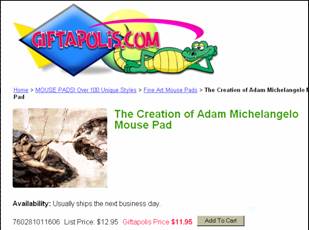
| •You can get a poster, a mug, a mouse pad.
(can be done with just photographic reproduction) |
|
| •But also go online. Unlike big coffee table book,
seeing the images is free online. |
|
| •Vatican web site online with images gets over 50
million hits/month. |
|
| www.vatican.va |
|
| Image Economy:
In a book the image doesn’t replicate itself—on the Web it does. |
|
| •Over 100 versions online (Google image search) and many
more with regular search |
|
| •But are they “legal”? |
|
| You can’t just
make a mousepad with this image—you need to license it. Gift-o-polis
probably did pay photo rights money, but what about the art history students
who copy the image for their personal use? What is legal and how can anyone
stop the proliferation of image once
it’s in digital form? |
|
| Can you download
this image and alter it for an art project? |
|
| Vatican
uses it as a graphic to advertise itself! |
|
| http://mv.vatican.va/3_EN/pages/MV_Home.html |
|
| who owns what and
what rights do you have to use, change, distribute digital images : as an
artist, teacher, reporter, or business? |
|
| Huge stock photo
agencies have emerged on the Web and it costs money to use their images… it’s
virtually impossible to find good photos of people for free on the Web
because you need permission from the people. |
|
| ______________________________ |
|
| SOURCES |
|
| http://www.giftapolis.com/creatofadmic.html |
|
| http://www.cbsnews.com/stories/2003/06/24/tech/main560158.shtml |
|