|
|
|
|
So, not too many
computer-related issues in the last example, but… now let’s look at impact of
reproduction at a whole new level…
|
|
|
|
Michelangelo, when he was painting the
Sistine chapel really wanted to be creating sculpture—he was forced to paint
it against his wishes.
|
|
One of his most
famous sculptures is his David.
|
|
Goal of Digital
Michelangelo Project was to make a 3D model that people can explore from any
point of view, different lighting, etc.
|
|
|
|
Visual Culture:
|
|
History: It’s
David from David Goliath story in the bible.
|
|
The statue of David
was started by a different artist, Agostino di Duccio, in 1463. He picked out
a rather narrow piece of stone, which was customary for artists of his
denomination. If you are an art expert, you can see from the side that
this is not a piece that Michelangelo would have picked. It is too thin.
http://vlsi.colorado.edu/~rbloem/david.html
|
|
Politically:
resonated with Florence and its situation within the city state of Italy
|
|
Also, aesthetically
very beautiful sculpture.
|
|
|
|
Already several
full-scale replicas in Florence.
|
|
|
|
Computer Graphics
and Visualization (CS): The Stanford
project, led by Marc Levoy, was a heroic proof-of-concept project costing
millions of dollars.
|
|
Not
replicable/scalable at this point. Going to tell you a bit about it because:
fascinating project, demonstrates some of the many implications of visual
computing for fields from art to tourism to philosophy, as well as technical
issues in computer graphics (papers on project published at SIGGRAPH and
elsewhere).
|
|
•3D scanning not new: People scan 3D stuff all the time,
cheap devices, used for movie special effects, etc., etc. but really good
quality, accuracy of large-scale delicate rare unmovable art works is a
different story.
|
|
|
|
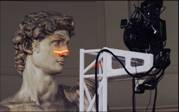
•Sampled sculpture at less than 1mm intervals (it’s over
5feet tall)
|
|
|
|
•Scanned with customize device but some parts of surface
self shading—had to use hands canners. Still spent hours trying to fill in
missing data—holes in the final model.
|
|
|
|
•Dealt with
|
|
--had to hire 24
security guard
|
|
--had to have shifts
and scan all night to get done in time frame of grant and italian gov.
|
|
--had to use manual
controls and encase parts of the scanner in foam to ensure no accidental
damage to sculpture
|
|
--had to account for
light falloff from actual lighting to create accurate model of surface that
could be lit any way a user desires in a 3D scene
|
|
--data sets huge
(many gigabytes) and hard to deal with.
|
|
|
|
|
|
•2mm accuracy
|
|
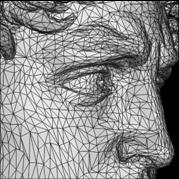
•4 million polygons—triangles-- in the head.
|
|
•8 million for entire statue.
|
|
|
|
•Raw data was over 2 billion triangles
|
|
|
|
•Head takes 12 hours to render.
|
|
|
|
•Veining and reflectance artificial. Renderings include
physically correct subsurface scattering, but with arbitrary parameters.
|
|
•Data for flawless, watertight, full-resolution model of the
entire statue, with color = 2 billion polygons and 7,000 color images,
occupying 32 gigabytes.
|
|
•3D graphics in general incorporates most of the concepts
learned in 2D graphics—the texture maps and “7000 color images” referred to
are all raster data—something we’ll be learning about in a few weeks. Artists
, scientists, art historians, and others will need to know the basic
terminology and concepts in this field.
|
|
|
|
Harder to make this
data useful than originally thought—needed cleaning” and datatsets are huge.
http://graphics.stanford.edu/data/mich/
|
|
Digital Michelangelo
Project
|
|
Model issues: noisy
data, misaligned meshes, holes.
|
|
Sounds conceptually
simple but very challenging—equipment, logistics, angle of laser when
scanning, scattered light from marble surface, dirt on sculpture, limits on
dataset size (huge but could have captured more info, but dataset would have
been unmanageable). Vibrations,
|
|
<1mm to 5feet
tall for david. Huge dynamic range 20,000 to 1.
|
|
“However,
reconfiguring the pan-tilt [scanning] assembly proved more problematic. In
retrospect, this should not have surprised us; 11 microns of play - 1/10 the
diameter of a human hair - in a pin and socket joint located 5 cm from the
pan axis will cause an error of 0.25 mm at our standoff distance of 112cm. In
general, we greatly underestimated the difficulty of reconfiguring our
scanner accurately under field conditions.
|
|
Range scanning. A
typical range scan consisted of several concentric curved shells separated by
translational motion of the scan. We often spent hours positioning the gantry
in fruitless attempts to fill holes in our model of the David.
|
|
Issues of laser
possibly damaging statue –no.
|
|
But did have to use
manual controls for automatic scanner head movement to ensure no damage. scan
head encased in foam rubber.
|
|
|
|
|