
1/27/2005
slide 15

Visualization of the Model
•Entire statue in color
–2 billion polygons
–7,000 color images,
–32 gigabytes.
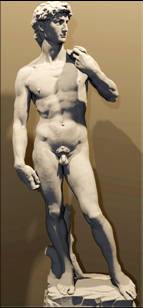
Rendering 1999
by Henrik Wann Jensen
| Image Economy
(or model economy; ): Q: Why scan this particular statue? Who
should support financially the scanning of heritage objects and
sites,? |
|
| Who owns the
scans? |
|
| If a site is a heritage site should they
be free for people in that culture—or the world at large? |
|
| Who controls them? |
|
| Who determines in
what ways they can be altered? |
|
| You cannot
automatically download this data from the Web : |
|
| “The models in
this archive are available to anyone, but for scientific use only, and users
must first obtain a license in writing from us. Although these
licenses prohibit commercial use of the models, permission for such uses can
be obtained by applying to the Italian government. “ [DM
Project web site] |
|
| •The license includes permission from the Stanford group as
well as the Italian government and indicated that royalties would have to
be paid for money-making commercial projects such as selling replicas. |
|
| •Just as a further note on this, notice that I included an
attribution for this particular rendering. So the IP for this image is
spread out among at least three people/organizations: Michelangelo (now
the Italian government), Marc Levoy and the Digital Michelangelo
project, and Henrik Jensen) |
|
| ++++++++++++++++++++++ |
|
| Obviously some
technical background is necessary to even know what the description of this
model means: |
|
| --in general,
polygons straight-sided closed shapes, but in CG they refer to the triangles
in the triangular “mesh” you saw in the slide before |
|
| --”veining” and
“reflectance” refer to the commonsense use of these terms when describing a
stone. [is the “veining” of the stone or painted veins of the David? I think
the stone…] |
|
| --“subsurface scattering” refers to
procedural (algorithmic) methods of simulating the scattering of light below
the physical surface of an object. Marble has this property, which is one of
the reasons it’s such a beautiful stone. Early computer graphics looked like
plastic—current CG effects include sophisticated simulation of real physics
of light interacting with material [back ref “computation of everything] |
|
| 3D graphics in
general incorporates most of the concepts learned in 2D graphics—the texture
maps and “7000 color images” referred to are all raster data—something we’ll
at in a moment. Artists , scientists, art historians, and others wil ned to
know the basic terminology and concepts in this field. |
|