
1/27/2005
slide 17

The Buddhas at Bamiyan
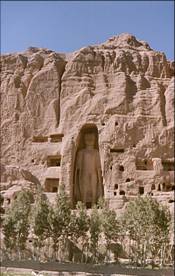
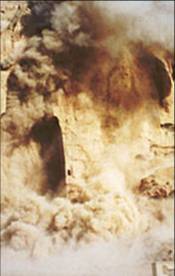
| Buddhas at Bamiyan,
blown up by the Taliban in March 2001 |
|
| •Visual Culture: cultural history, religious history,
art history -- should this be done? Simulacrum, etc. relationship to Benjamin |
|
| •Art and Design: aesthetic value of works, way they
are in the rock/landscape interesting… |
|
| •Vision Science: issues of scale |
|
| •CG: reconstruction-discuss. Unlike the david, were
not scanned at close range. Depth measurement deduced from serios of 2D
phtoos. |
|
| •Image Economy: already millions of dollars allotted
for shoring up remaining structure. 30m estimated to rebuild. Who will pay?
Who will “own “ results? Who owns files? Etc. |
|
| •Philosophy: effect of looking at simulation of “real
Sculptures. How different or same as looking at photo (intention different?),
how related to simulacra of Lasceaux, or doors of The octagonal baptistery of
San Giovanni showing “gates of Paradise” by Ghiberti. |
|
| •We will be discussing on Thursday... Will read brief
description from UNESCO world heritage site: |
|
| From UNESCO Site:
http://whc.unesco.org/pg.cfm?cid=31&id_site=208 |
|
| The cultural
landscape and archaeological remains of the Bamiyan Valley represent the
artistic and religious developments which from the 1st to the 13th centuries
characterized ancient Bakhtria, integrating various cultural influences into
the Gandhara school of Buddhist art. The area contains numerous Buddhist
monastic ensembles and sanctuaries, as well as fortified edifices from the
Islamic period. The site is also testimony to the tragic destruction by the
Taliban of the two standing Buddha statues, which shook the world in March
2001. |
|
| Threats to the
Site: The Cultural Landscape and Archaeological Remains of the Bamiyan Valley was inscribed on the List of World Heritage in Danger at the 27th session of the World Heritage Committee simultaneously with its inscription on the World Heritage List. The property is in a fragile state of conservation considering that it has suffered from abandonment, military action and dynamite explosions. The major dangers include: risk of imminent collapse of the Buddha niches with the remaining fragments of the statues, further deterioration of still existing mural paintings in the caves, looting and illicit excavation. Parts of the site are inaccessible due to the presence of antipersonnel mines. |
|
| Justification for
Inscription |
|
| Criterion (i):
The Buddha statues and the cave art in Bamiyan Valley are an outstanding
representation of the Gandharan school in Buddhist art in the Central Asian
region. |
|
| Criterion (ii):
The artistic and architectural remains of Bamiyan Valley, and an important
Buddhist centre on the Silk Road, are an exceptional testimony to the
interchange of Indian, Hellenistic, Roman, Sasanian influences as the basis
for the development of a particular artistic expression in the Gandharan
school. To this can be added the Islamic influence in a later period. |
|
| Criterion (iii):
The Bamiyan Valley bears an exceptional testimony to a cultural tradition in
the Central Asian region, which has disappeared. |
|
| Criterion (iv):
The Bamiyan Valley is an outstanding example of a cultural landscape which
illustrates a significant period in Buddhism. |
|
| Criterion (vi):
The Bamiyan Valley is the most monumental expression of the western Buddhism.
It was an important centre of pilgrimage over many centuries. Due to their
symbolic values, the monuments have suffered at different times of their
existence, including the deliberate destruction in 2001, which shook the
whole world. |