
1/27/2005
slide 20

Pop Quiz (from
museumofhoaxes.com)
•http://www.museumofhoaxes.com/tests/hoaxphototest2.html
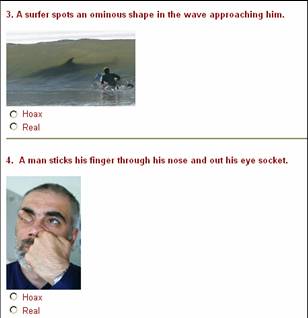
| SHARK |
|
| A real, unaltered
photo taken by photographer Kurt Jones on April 19, 2003 (you can order
prints of the photo from his website). But that's a dolphin in the wave...
not a shark! |
|
| ICKY |
|
| I hope no one fell
for this obvious gag. The man's finger has simply been digitally pasted over
his eye. |
|
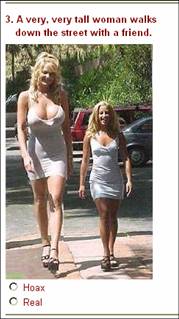
| WOMEN |
|
| The tall woman on
the left in this picture is a real woman. Her name is Heather Haven, and she
has her own website that includes many photos showing off her above average
height. But this picture in particular shows evidence of having been
digitally altered. To the right of her legs you can see a region where the
shadows and light don't match up with the rest of the picture, evidence of a
clumsy cut-and-paste job. |
|
| Common sense,
sometimes examining the photo can help (not usually when this small). |
|
| Provenance and
meaning of a photo is not obvious. Easy to make something where you
cannot tell without some research whether it is real or not. |
|
| Visual Culture
of faking things with traditional photo techniques. This often stated (even
before digital technology entered the picture) by various theorists
(Barthes—photo message without a code” now widely disbelieved, |
|
| Perception:
why do photos look more “real” than painting? Effects of Perspective, color,
detail, etc. |
|
| • Why, even though we have become more sophisticated viewers
of visual material, do we still attribute “reality” to this type of
image production? |
|
| •Perceptual research can also tell us what types of things
we can change easily in a photo—why we could replace Oprahs’ body, but
not her face, for instance. |
|
| •The perceptual systems can be tricked—avenues for artistic
expression |
|
| Economics:
(and perception and media) when I found out the fish photo was real, I
wanted to buy a print. If it had been fake, I would have been less
inclined to—why? I wasn’t there, don’t know the surfer, why would it matter? |
|
| CG: we looked
at the underlying data representation for photo-editing—but what about
pictures made with 3D models, which have a different type of data
representation (those triangular meshes, for instance, that we saw earlier). |
|
| Many viewers still assume that if
something looks photographic, it was at the worst made up of different photos,
or manipulated. But we can make realistic images with only 3D model
data. |
|
| Philosophical:
Since we see many more photos of things that real things, what does it matter
if they are real or not? Does it? When does it matter? |
|