|
|
|
So Semiotics does
make some assumptions about the role of language in thought that not everyone
agrees with.
|
|
But even the most
violent opponents of the “language-as-thought” crowd have to
admit that we do use language A LOT for thinking and that it would be pretty hard to
get by without it. This lecture would be really short, for instance.
|
|
|
|
And it is important
to be able to talk about images.
|
|
|
|
Semiotics does take
images and their power seriously
|
|
One of the
interesting and effective things about semiotics has been that it takes a wide
range of images as its material for study. In fact, anything visual can
de studied—and is! From Renaissance painting to TV to Madonna to, and
more.
|
|
|
|
While art history
and other academic visual disciplines (parts of engineering, for instance)
rarely address our everyday cultural materials (other culture's materials
are OK to study—anthropology, but not our own), semiotics has made
advertising, family snapshots, and movies its main areas of study. [story
about wanting to research rolling stones in HS].
|
|
No accident that
what was formerly “art and semiotics” is now a department of
“Modern Culture and Media”
|
|
|
|
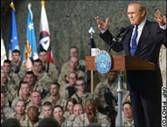
What does the image
on the left “say” about Rumsfeld? Note flags, podium, uniforms
(soldiers and him)
|
|
How is our notion of
outer space affected by images such as this Hubble image? Did you know that
these are taken in black in white? What goal might the “prettification
of space” have?
|
|
On the right: how
have architectural elements from other periods been drawn together to give
rich mcMansion owners a cultural veneer?
|
|
|
|
SOURCES
____________________
|
|
U.S. Secretary of
Defense Donald Rumsfeld speaks to troops in Kuwait on Wednesday.
|
|
http://www.cnn.com/2004/WORLD/meast/12/08/rumsfeld.troops.ap/index.html
|
|
|
|
http://hubblesite.org/newscenter/newsdesk/archive/releases/2004/35/
|
|
|
|
|
|
NOTE
|
|
|
|
Andy disturbed by
not seeing anything about what it is that is being communicated
|
|
|