|
|
|
Foucault is known
for his analysis and critique of the discourses of insanity—what is
normal? How is normality defined and how is non-normality or insanity dealt
with?
|
|
|
|
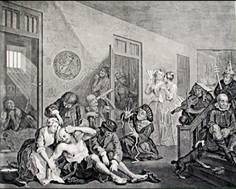
Rake’s
Progress (1730s) [society causes illness, insane people are fun to
watch—are subhuman]
|
|
Modern Psychiatric
hospital (20th c) [environment can help reduce or cure
problems—safe, lack of stimulation, etc. people treated with respect
–hospital for the mind vs. body]
|
|
Antipsychotic drugs.
problem is not in society or environment but in our brains. Better living
through chemistry.
|
|
SOURCES
|
|
http://www.artoftheprint.com/artistpages/hogarth_william_arakesprogresscompletesetofeight8.htm
|
|
Plate 8: A
Rake's Progress ends in the famous madhouse, Bethlehem Hospital (Bedlam).
Chained, half-naked, and in great anguish is our final view of Tom Rakewell.
Faithful to the end, Sarah Young attempts to give him whatever comfort she
can. One keeper attends to Tom's chains while another molests
Sarah. This particular image is among Hogarth's greatest and most
damning indictments of society. Its cast of tormented characters points to
the many causes of madness. Behind Tom and Sarah, science has claimed two
victims. One studies the stars through a useless role or tube of paper, while
another scribbles geometric calculations on the wall. Religion, too, has led
to madness. In the cell to the left, a tormented, half-animal, soul worships
his cross. To the extreme right a delusional man believes he is the Pope.
Beside him a musician madly plays his violin with a stick. On the steps a
love lost man has carved the initials of his obsession ('Charming Betty
Careless', who was a famous prostitute of the day) on the banister. Rounding
out this horrific scene is a mad tailor and, in cell 55, a naked delusional
King. Most disturbing, however, are the two, pretty aristocratic ladies
who have come to view the suffering of the insane as a form of entertainment.
Throughout this entire, masterful set, Hogarth has shown us the dangers of a
morally bankrupt society. Almost thirty years (1763) after completing A
Rake's Progress, Hogarth returned to this final plate and made one
significant addition. On the wall he etched an image of a halfpenny
portraying Britannia with her hair wildly flying behind her. Within the lower
margin he also wrote, "Retouch'd by the Author, 1763." In the last
year of his life, Hogarth clearly felt that Britain and its ruling classes
had not improved.
|
|
|
|
http://www.state.sc.us/dmh/bryan/tour.htm
G. Werber Bryan Psychiatric Hospital South Carolina
|
|
Well-designed
therapeutic environment:
Bryan clearly does not look "institutional". Set in pine
woods by a lake, the hospital more closely resembles a rural retreat or
resort than a hospital. It was designed to be a healing place.
Natural brick and wood materials plus interior open-to-the-sky atriums
compliment the rustic setting. Since Bryan provides short-term
acute care, the hospital layout maintains the real-life rhythms to which most
patients will soon return -- "bedroom suburbs" (lodges) ringing a
village "downtown" where one purposefully goes during the day to
accomplish the commerce and activities of community life.
|
|
|
|
http://pharma1.med.osaka-u.ac.jp/textbook/Antipsychotic/Antipsychotic.html
|
|
|
|
Chemical structure
of Chlorpromazine
|
|
Brain diagram:
Actions and side effects of antipsychotic drugs on DA neurons
|
|
“The drugs
works on (1) mesocortical DA system and (2) mesolimbic DA system, and
shows antipsychotic and sedative actions. Extrapyramidal effects are caused
by the inhibition of D2 receptor of (4) the nigrostriatal system. Secretory
inhibition such as prolactin is caused by DA block in the hypothalamus and
hypophysis system(3). In addition, there is an inhibitory action of central
histamine and serotonin receptors. Moreover, the side effects by inhibition
of peripheral muscarinic and alpha1 receptors are also produced.
“
|
|
|