|
1
|
- Last lecture:
- looked at neurophysiology of perception,
- high-level concepts such as figure-ground and depth cues.
- Today we’ll
- finish off high-level concepts
- go through the lower-level rules that are behind those phenomena
- I’m not srue exactly waht tihs dmesonaterts but it’s prtety cool. Can
you raed tehse setnecens?
|
|
2
|
- Wertheimer: Why do some things seem to “go to together?” Some principles
of grouping…
- Will cover grouping further in design lecture
|
|
3
|
- Covered in part in Fulvio Domini guest lecture on Optic Flow
|
|
4
|
- Mystery of vision and historical theories
- Ecological basis
- High-level perception concepts
- Figure-Ground
- Size constancy
- Depth and object solidity
- Lower-level: rules for image “construction”
- Visual Intelligence [Hoffman 1998] book has 35 rules that the
perceptual system uses to decode visual stimulus and create a useful
description of the world
- These underly the higher-level perceptual effects
- Perception research in the Visual Methodologies [Rose 2001] framework
|
|
5
|
- Art & design have guidelines–vision has some actual principles and
rules
- Some guidelines confirmed by rules, some not
- Knowing these can help us
- Understand how to make the most of the high-level concepts just covered
- E.g., subtleties of figures in figure/ground organization
- Better interpret visual materials
- Design better
- Understand why some designs fail
- Explains how much of visual world (and even abstract ideas) can be
conveyed with nothing but lines on paper.
|
|
6
|
- Image at eye has countless number of possible interpretations. [Hoffman
1998] p13.
- 2. Even though we have stereo vision, the image at each eye is 2D and
has countless interpretations in three dimensions
|
|
7
|
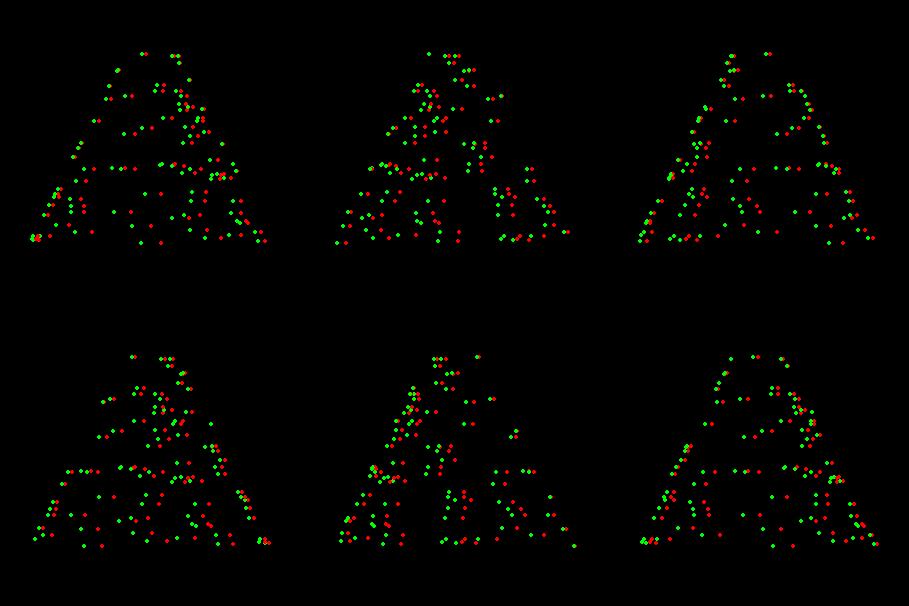
- In a RDS, a repeating pattern is used to make it easier to mistake one
element of the picture for another when viewed with crossed eyes
- The pattern is slightly altered and your (crossed) eyes think they have
converged on the same element—when in fact it is two different ones.
- Effect can happen with repeating wallpapers sometimes
|
|
8
|
- Construct only those visual worlds for which the image is a stable
(i.e., generic) view
- If changing view slightly changes image dramatically, then was not a
stable (generic) view
|
|
9
|
- “Always interpret a straight line in an image as straight line in 3D.” [Hoffman
1998 p27]
|
|
10
|
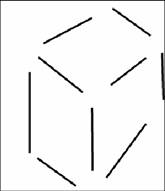
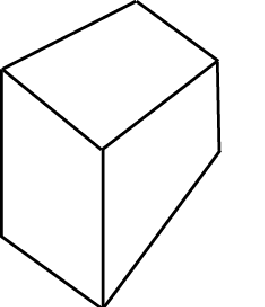
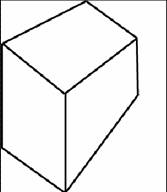
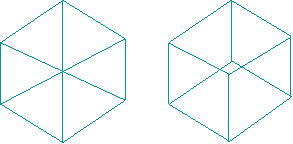
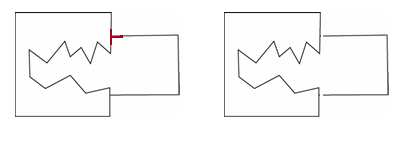
- “If the tips of two lines coincide in an image, then always interpret
them as coinciding in 3D.” [Hoffman 1998 p27]
|
|
11
|
|
|
12
|
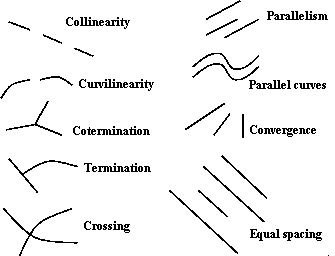
- Many of the rules in Hoffman apply to specific lines configurations in a
2D image
- These arrangements are statistically highly correlated with
non-accidental views of 3D reality
|
|
13
|
- “Always interpret lines collinear in an image as collinear in 3D.” [Hoffman
1998 p31.]
|
|
14
|
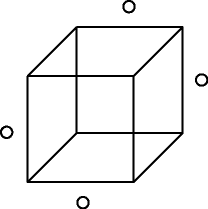
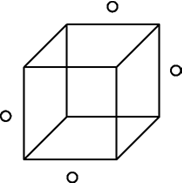
- “Interpret elements nearby in an image as nearby in 3D.” [Hoffman 1998
p32]
- Aka a “proximity” effect
- “As you observe the cube, note that two of the circles seem closer to
you, and two further away. When the cube reverses in depth, so do the
circles, suggesting that human vision assigns depth to the circles based
on the depth it assigns to nearby portions of the cube.” [Hoffman 1998
p32.]
- This demonstration was devised by Marc Albert, motivated by work of
Allan Jepson and Whitman Richards.
|
|
15
|
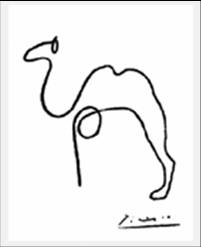
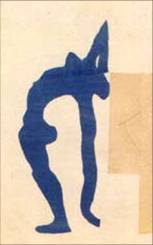
- “Always interpret a curve that is smooth in an image as smooth in 3D.” [Hoffman
1998 p33.]
- “Where possible, interpret a curve in an image as the rim [contour/edge]
of a surface in 3D.” [Hoffman 1998 .p.39]
- i.e., as bounding part of a surface, not just a curved line hanging out
in space
|
|
16
|
- How 3 dimensions get flattened into 2 on retina—reconstructed to 3D in
brain
- Natural perspective: why moon can block sun
- Formal rules of linear perspective: Brunelleschi et al (more on this
later in course)
|
|
17
|
- “Where possible, interpret a T-junction (aka or J-junction) in an image
as a point where the full rim conceals itself: the cap conceals the
stem.” [Hoffman 1998 p.39]
- Explains interposition (overlapping)
depth cue from earlier
|
|
18
|
|
|
19
|
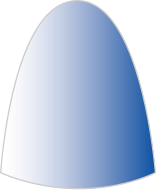
- Convex
- Like an egg shell
- Curves down for observer at any point on surface
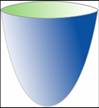
- Concave
- Like inside of egg shell
- Curves up for observer at any point on surface
|
|
20
|
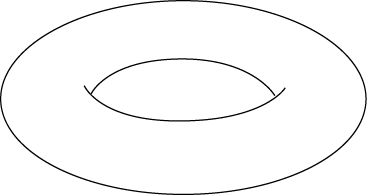
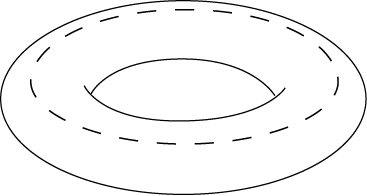
- Surfaces can only curve in these three ways!
- Convex regions usually bound a material/object
- Concave regions usually bound pockets of air (aka negative space)
- Saddle regions bound nothing—instead provide transition between convex
and concave (this type of surface often not acknowledged in art theory)
|
|
21
|
- Rule 8: “Interpret convexities in a silhouette as convexities in 3D.” [Hoffman
1998 p.42]
- Rule 9: “Interpret concavities in a silhouette as saddles in 3D.” [Hoffman
1998 p.42]
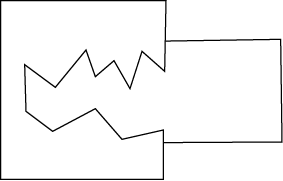
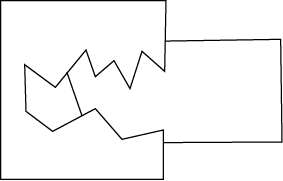
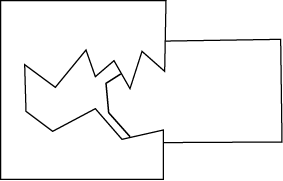
- Rule 10: “Construct surfaces in 3D that are as smooth as possible” [Hoffman
1998 P. 43]
|
|
22
|
|
|
23
|
|
|
24
|
- From [Massironi 2001 p.217] The Psychology of Graphic Images: Seeing,
Drawing, Communicating,
|
|
25
|
- Construction of objects preconscious—we don’t notice it when it’s
working
- Mr. S [Hoffman 1998 p.49] could “see” but not construct objects
- Saw color, motion, edges but could not determine what objects they
represented
- Still knew what objects were (could touch, hear them) but couldn’t put
the pieces together
|
|
26
|
- Construction of objects preconscious—we don’t notice it when it’s
working
- Mrs. B constructed objects that weren’t there [Hoffman 1998 P 76]
- After stroke could still read, recognize faces but…
- Vivid, realistic hallucinations of traffic, children, animals, and more
|
|
27
|
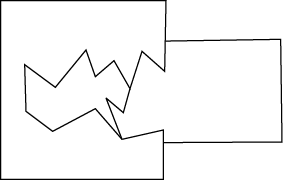
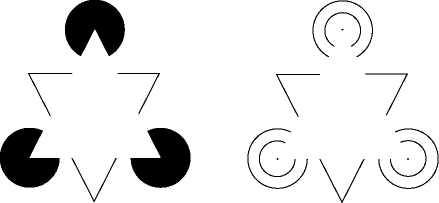
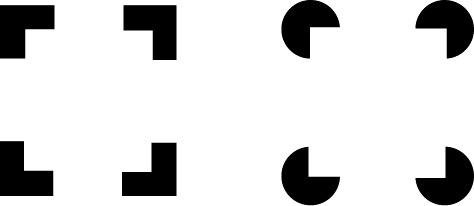
- “Construct subjective figures that occlude only if there are convex
cusps.” [Hoffman 1998 p.57]
|
|
28
|
- “If two visual structures have a non-accidental relationship, group them
and assign them to a common origin.” [Hoffman 1998 p.60]
|
|
29
|
- Rules 17 and 18: salience of a cusp increases with angle at cusp and
salience of a smooth boundary increases with magnitude of curvature
- I.e., the more spiky and protruding, the more likely to be “figure” vs.
“ground”
- “Choose figure and ground so that figure has “more salient parts” (rule
20, [Hoffman 1998 p102])
|
|
30
|
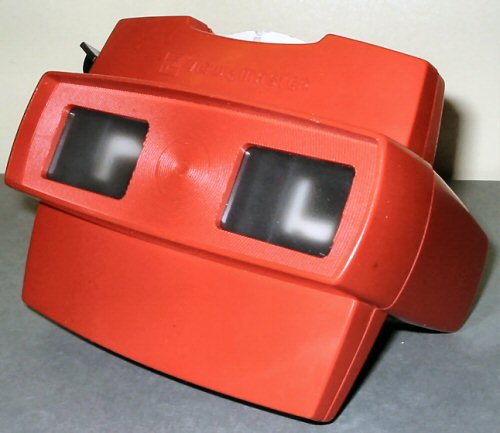
- Binocular vision helps give us sense of depth
- Only noticed recently (relatively speaking) in 1838 by Charles
Wheatstone!
- More in CS graphics lecture
|
|
31
|
- Mystery of vision and historical theories
- Ecological basis
- High-level perception concepts
- Figure-ground
- Frame of reference
- Depth cues
- Lower-level: rules for image “construction”
- Visual Intelligence book has 35 that the eye-brain use to decode visual
stimulus and create a useful description of the world
- These are behind the higher level perceptual effects
- Perception research in the Methodologies framework
|
|
32
|
- Approach
- Take images seriously (goal of Power of Images lectures) yes
- Consider the social context in which the image was made and is viewed not
really
- Consider your own “ways of seeing”
yes (vision mediated by perceptual system, no guarantee we all
see the same things)
- Examine one or more of the three steps in visual message process
- Production of image (how it is made) ? Not sure
- Image itself (what it looks like) yes
- Audience (how it is seen) perhaps not in intended sense (brain injured
an audience)
- Key factors to consider
- Technological (tools used) ?
- Compositional (formal design strategies) yes (by nature vs. people)
- Social (economic, political, social relations, institutions and
practices, cultural settings, etc.) somewhat-perceptual findings often
relevant
|
|
33
|
- How do higher-level issues fit into ecological theories of vision?
Science of beauty interesting example: combines issues of
- Power of images
- Power of media
- Gender roles
- Psychology
- Evolutionary theory/ecology
- Gestalt: symmetry, grouping (beauty as symmetry study)
- Ectoff describes research showing perception of female beauty may be in
part hard-wired
|
|
34
|
- Almirantis, Y. 1995. Left-right asymmetry in vertebrates. BioEssays
- Cancar, D. 1995. Sex and the symmetrical body. New Scientist
- Enquist, M., A. Arak. 1994. Symmetry, beauty and evolution. Nature
- Etcoff, N. 1999. The Beauty of Science, Survival of the Prettiest
- Eugene, A. 1998. I Want To Be Beautiful, interview
- Gould, S. J. 1998. The allure of equal halves. The Sciences
- Grammer, K., R. Thornhill. 1994. Human (Homo sapiens) facial
attractiveness and sexual selection: the role of symmetry and
averageness. Journal of Comparative Psychology
Symmetry and beauty
- Mealey, L., R. Bridgstock, G. C. Townsend. 1999. Symmetry and perceived
facial attractiveness: a monozygotic co-twin comparison. Journal of
Personality and Social Psychology
- Samuels, C. A., G. Butterworth, T. Roberts, L. Graupner, G. Hole. 1994.
Facial aesthetics: babies prefer attractiveness to symmetry. Perception
- Scutt, D., J. T. Manning. 1996. Symmetry and ovulation in women. Human
Reproduction
- Swaddle, J. P., I. C. Cuthill. 1995. Asymmetry and human facial
attractiveness: symmetry may not always be beautiful. Proceedings of the
Royal Society of London, Series B: Biological Sciences
- UTMB, Galveston, TX - Dept of Otolaryngology - Facial Analysis; October
1, 1997
- http://www.uni-regensburg.de/Fakultaeten/phil_Fak_II/Psychologie/Psy_II/beautycheck/english/index.htm
|

 Notes
Notes