1/28/2004   slide 6
Range of Representations
•Lines (e.g., in pen&ink illustrations) can represent
–Objects
–Edges (contours, silhouettes, etc.)
–Cracks
–Textures
•
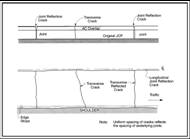
FIGURE 16.  Distress Type ACP 5 - Reflection Cracking at Joints, Schematic drawing of asphalt concrete pavement with distress type ACP 5 - reflection cracking at joints.  The drawing shows two lanes of a pavement surface; the upper lane as it would be viewed in layers from the side, and the lower lane as it would be viewed from above with a dashed center line in the middle and edge stripe and shoulder at the bottom.  An arrow indicates that the traffic moves toward the right side of the drawing.  The lane in the upper part of the drawing shows three cracks in the pavement.  Two are joint reflection cracks of the asphalt concrete overlay; one of medium width and penetrating to approximately half the depth of the overlay, the other is wider and penetrates the entire depth of the overlay.  The third crack is a transverse crack that penetrates the entire depth of both the asphalt concrete overlay and the original jointed concrete pavement layer.  The lane in the lower part of the drawing shows three transverse reflected cracks that cross the entire width of the lane, and a series of longitudinal joint reflection cracks along the entire length of the center line.  It is noted that uniform spacing of cracks reflects the spacing of underlying joints.
http://www.solarnavigator.net/inventors/inventor_images/leonardos_helicopter.jpg
http://www.angelfire.com/electronic/awakening101/leonardo.html (head)

http://www.tfhrc.gov/pavement/ltpp/reports/03031/01.htm#acracking [cracks]