
1/28/2004 slide 7

Gestalt Theory
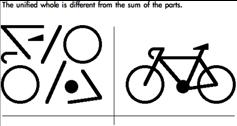
•Developed in Germany in early 1900s. Response to reductionist methods of science
•“There are
wholes, the behavior of which is not determined by that of their individual elements, but where the part-processes are
themselves determined
by the intrinsic nature of the whole. It is the hope of Gestalt theory to determine the nature of such wholes.”
Max Wertheimer, 1924 http://gestalttheory.net/archive/wert1.html#fn1
Max Wertheimer, 1924 http://gestalttheory.net/archive/wert1.html#fn1
–No one ingredient (or all of them randomly thrown together) make a cake—need recipe
–Detail elision
–Hierarchy of abstraction
•Use in psychology, art,
other fields, as well as
vision science and
perception
other fields, as well as
vision science and
perception
http://www.atpm.com/9.10/design.shtml